
Shredder Blade Material Cr12MoV and SKD11 Comparison and Application
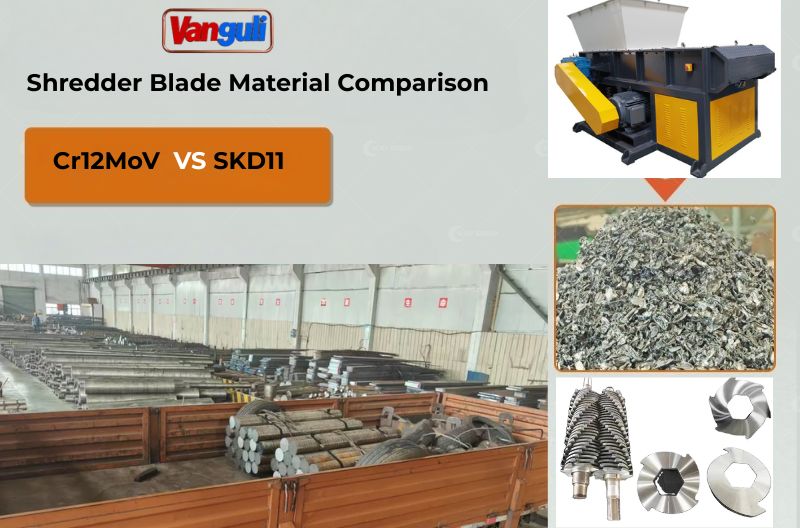
Shredder blade material is the key factor for shredders. Cr12MoV and SKD11 are both well-known. What is the difference between them? Which one is more suitable for your needs? Let's have a hardcore comparison today.
1. Composition Reveal
Cr12MoV is the star player of our domestic mold steel, with a carbon content of about 1.45%-1.70%, a chromium content of 11.00%-12.50%, and molybdenum and vanadium assist. Molybdenum can improve hardenability and toughness, while vanadium forms carbides to improve wear resistance and hardness.
SKD11 is a veteran in Japan, with a similar composition to Cr12MoV, but more sophisticated in trace element control and smelting process. Its carbon and chromium content are close to Cr12MoV, and its performance is also excellent, with a more stable composition and advanced technology.
2. Performance Comparison
Hardness and Wear Resistance of Shredder Blade Material
After quenching and tempering, the hardness of Cr12MoV can reach HRC58-62, and its wear resistance is good, which can meet most cold-working mold requirements. For example, in the mold for stamping ordinary steel plates, it can perform stably and keep the mold edge sharp for a long time.
The hardness of SKD11 is slightly better, reaching HRC60-64. The carbide distribution is more uniform, and the wear resistance is stronger. When processing alloy steel stamping parts with higher hardness, the service life of the SKD11 mold is much longer than that of the Cr12MoV mold.
Toughness and Fracture Resistance
Cr12MoV has relatively good toughness and is not easy to break when subjected to a certain impact load. When manufacturing molds with complex shapes that require a certain toughness, their performance is very impressive.
Due to its high carbon content, SKD11 has more carbides in its structure, and its toughness is slightly inferior to Cr12MoV. When subjected to a large impact, it is more likely to crack.
Hardenability
Cr12MoV has good hardenability. For larger mold parts, it can ensure that the entire cross-section has good performance.
SKD11 has excellent hardenability. Even for large-sized molds, after quenching, it can achieve uniform hardness on the surface and core, and good performance consistency.
3. Different Application Scenarios of Shredders
Cr12MoV has high-cost performance and is suitable for scenarios where performance requirements are not extremely high. For example, small hardware stamping molds and general stretching molds can ensure mold performance and control costs.
SKD11 is more suitable for high-precision and high-demand mold manufacturing. For example, precision stamping molds and cold extrusion molds need to maintain mold accuracy and wear resistance for a long time. SKD11 can meet production needs with its excellent performance. For example, shredders are used for various metal recycling.
4. Summary
Cr12MoV advantages: good toughness, high-cost performance, suitable for ordinary cold-working molds. The disadvantage is that the hardness and wear resistance are slightly inferior, and the performance in high-precision scenarios is average.
SKD11 advantages: high hardness, strong wear resistance, good hardenability, suitable for high-precision molds; disadvantages are poor toughness and relatively high cost.
Customers can choose according to their needs and budget, or tell us the application scenario of the tool, and we will choose the right tool material for you.
