
How to Make Slitter Blades
1. Ingredients of The Slitter Blades
Batching of slitter blades is the first and key step. Batching requires accurate batching of appropriate tungsten carbide powder, cobalt powder, and additives according to the performance requirements of cemented carbide. Usually, it uses two materials.
White steel blades, also known as high-speed steel blades, this kind of tool has good toughness and high slitting efficiency, but poor slitting sharpness. Generally, when using this kind of tool, it is necessary to adjust the speed appropriately to compensate for the unsharp phenomenon that may be caused during the slitting process. This kind of blade is mainly used for slitting PET material, PE material, and other hard materials. The price is relatively cheap, more practical, and it is a common tool.
Tungsten steel blades, this kind of tool is brittle and sharp, and is generally used for slitting soft materials such as double-sided adhesive. The cutting precision of this tool is good, and burrs and wire edges are less likely to appear during the cutting process. However, this tool is prone to chipping for relatively hard materials. The tool cost is relatively expensive, and general manufacturers only use it to cut relatively soft materials such as tape, PE film, and masking paper.
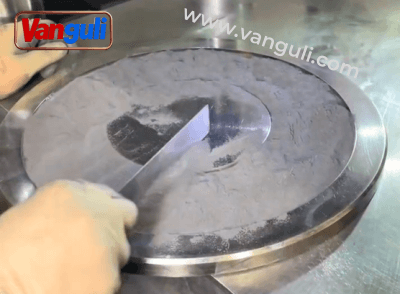
2. Pressing
Pressing is to put the ingredients into the mold for pressing to obtain a cemented carbide blank of basic shape and size. During the pressing process, it is necessary to control parameters such as pressing pressure, temperature, and time to ensure the density and strength of the slitter blades.
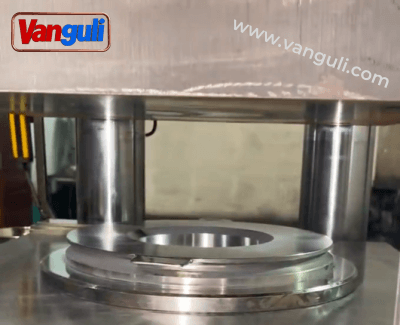
3. Sintering
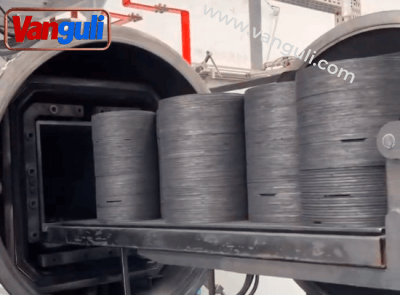
Sintering is an important link in the production of cemented carbide circular slitter blades. Through the high-temperature sintering process, the tungsten carbide particles in the cemented carbide blank are bonded with cobalt to form a cemented carbide material. During the sintering process, it is necessary to control parameters such as sintering temperature, time, and atmosphere to ensure the density and strength of the cemented carbide material. At the same time, it is also necessary to prevent problems such as oxidation and deformation during the sintering process.
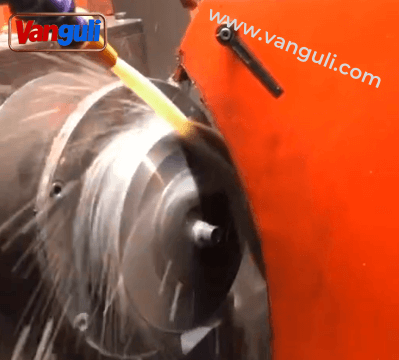
4. Grinding
Grinding is to finely grind the cemented carbide blank to make its surface smooth and achieve the required dimensional accuracy. During the grinding process, it is necessary to select appropriate grinding tools and grinding parameters to ensure the improvement of grinding efficiency and grinding quality.
5. Edge treatment
Edge treatment is to grind and polish the edge of the carbide circular slitter blades to give them the correct shape and sharpness.
6. Inspection
Inspection is the last step in the production of carbide circular slitter blades, including testing of dimensional accuracy, hardness, wear resistance, etc., to ensure that the product quality meets the requirements.
