
Economic Clothing Recycling Machine Blade Material 65Mn
When customers choose a clothing recycling machine, they need to see the blade material. It affects the working efficiency and lifespan largely. Today, let's take a quick look at steel material 65Mn's advantages, disadvantages, and applicable scenarios!
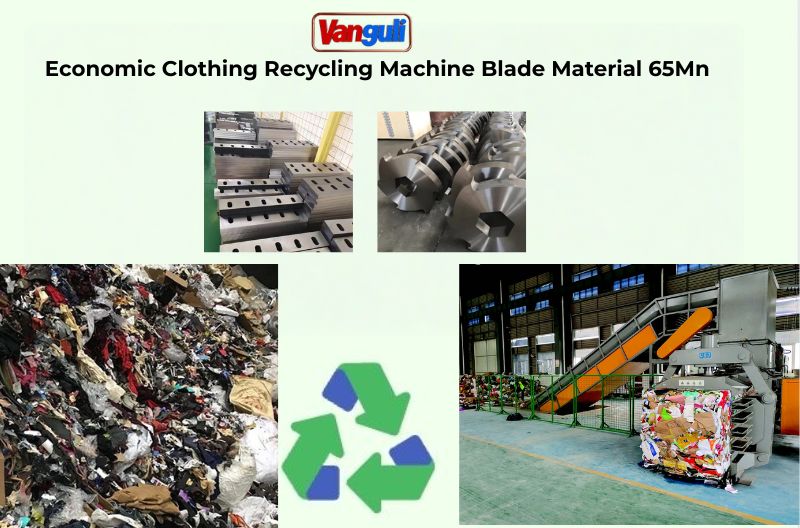
In the field of industrial materials, 65Mn occupies a place with its unique performance. It is suitable for the small-scale production of mini crushers or mini shredders. It’s an economic choice for clothing recycling, plastic film recycling, and other soft waste recycling.
1. 65Mn Composition
65Mn belongs to spring steel with a carbon content of about 0.65%. The addition of manganese makes its performance better than ordinary carbon steel. The main components of iron, carbon, and manganese are matched with a small amount of silicon, sulfur, and phosphorus, giving it special properties.
2. 65Mn Material Advantages
In terms of mechanical properties, the hardness can reach HRC40-48 after heat treatment, and the high strength and high hardness allow the parts to withstand large loads. Good elasticity makes it an ideal choice for the manufacture of automotive seat springs, suspension springs, etc.
In terms of processing performance, the tool wear is small during cutting, and the performance can be flexibly adjusted through different heat treatments such as quenching and tempering. At the same time, compared with high-performance alloy steel, 65Mn is affordable and is favored in cost-sensitive industries such as furniture and general machinery manufacturing.
3. Disadvantages of 65Mn Material
65Mn also has shortcomings. The hardenability is limited, and large-sized parts are prone to surface hardness and softcore after quenching; the corrosion resistance is poor, and it is easy to rust in a humid or corrosive environment. When subjected to alternating loads, the fatigue performance is generally poor, and it is easy to crack after long-term use.
4. Application scenarios of 65Mn material
Based on these characteristics, 65Mn is widely used. Spring manufacturing is its main battlefield, and it can be found in springs from cars to watches. It is also used to manufacture tool measuring tools, such as woodworking saw blades and small files, as well as mechanical parts, such as small shafts and gears, and furniture accessories such as sofa springs and wardrobe hinges. It is suitable for the small-scale production of mini crushers or mini shredders. It’s an economic choice for clothing recycling, plastic film recycling, and other soft waste recycling.
What other industrial tool materials do you want to know? Please contact us. Thank you.
